
A self-absorbed nativity scene for our times
This article first appeared in Malta Today
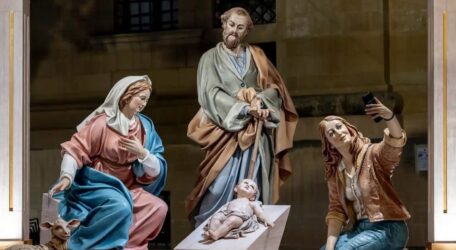
The nativity scene in Valletta by sculptor Michael Cutajar Zahra has sparked a lot of online chatter because it features a young woman taking a selfie with baby Jesus.
It has been described as “an age-old Christmas tradition meets the smartphone generation”, and has caused quite a stir, as the artist intended. Given the fast pace of modern life, “I wanted people to first see the traditional Mary and Joseph and then, when they notice the girl, to stop, pause and reflect,” said Cutajar Zahra.
Art which provokes the audience is always subjective and if it gets people talking then it has achieved its aim. I wonder, however, how much it has caused people to “pause and reflect” rather than simply rubbing them the wrong way. From comments I read, many seem to have taken it literally and have interpreted it as condoning the selfie trend. The ironic tone of the whole thing was lost on them and they couldn’t see past what they concluded was the ridicule of a sacred image which is symbolic of Christmas. In this current very charged climate, I doubt whether Maltese people are quite willing to accept tongue-in-cheek humour about something as deeply rooted in our Christian traditions as the nativity scene…even if the humour was intended to make a point.
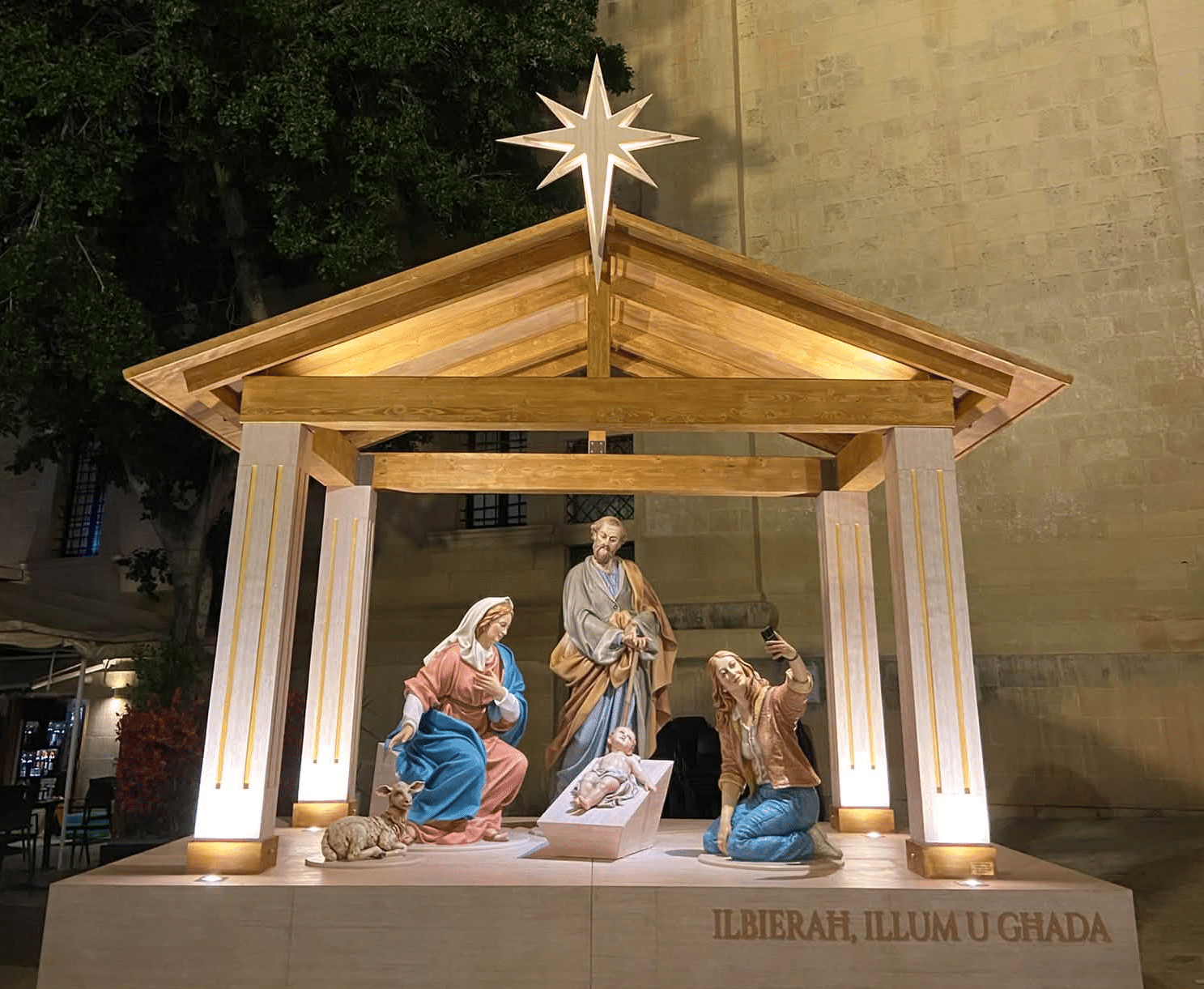
Taken at face value, the inappropriateness of the selfie taker inserted so glaringly with Mary, Joseph and Jesus is a juxtaposition which jars and offends. But if we look deeper, this really is a reflection of our times where photos are taken at every opportunity and nothing seems to be off limits any more. Mothers who have just given birth, people dying or on their death bed, even families at a cemetery are photographed, but it does not stop there, because the sole purpose is to upload and share the images on social media for others to see.
The selfie takes it one step further because the event, no matter how private and intimate, ceases to be the main focus but it becomes about the person taking the photo. Look at me, look at me – the narcissism which selfies have encouraged and perpetuated has taken on breathtaking proportions and includes a lot of virtue signalling (look what a good person I am, putting flowers on the grave). It has also served to make us even more ego-centric, preventing us from enjoying occasions which are supposed to be about other people; who cares about the bride and groom or a performer on stage when the important thing is to take a selfie to show that I was there.
There is also a new compulsion I’ve noticed, which we see on a daily basis, where people post reels about what personal issues they are going through or what they think on any given subject. There are those who chronicle their day: the life of a stay-at-home mum for example, who does all her carefully staged errands for the benefit of the camera. Influencers, of course, have made a career out of this, with the camera phone propped up in a professional, strategic way complete with ring light, to promote the brands which sponsor them. But it is the ordinary people who intrigue me the most, proclaiming their opinion on current events or sharing the humdrum of their everyday life with anyone who cares to watch and listen. If they are having a bad day they promptly record themselves crying. I find it all very fascinating, this need to talk to camera and self-publish one’s emotions on such a public platform. It is an extension of the selfie culture taken to another level, but it is also about the dopamine hit which we get for every “like” and emoji. The attention and validation from strangers which stroke the ego can be very seductive and addictive but sadly, also sometimes replace real meaningful interactions with family and friends in real life. It makes me wonder: how many of us are able to exist without taking selfies and posting them to keep us “relevant”?
The emphasis on the self goes even beyond that because it is also reflected in the way we treat each other. The lack of consideration and self-absorption can be seen everywhere, from the way we drive, the way we cross the road (why walk a few metres to use a zebra crossing when you can just zigzag between oncoming traffic?), the pushing and the shoving in crowds, the blare of voices from people having conversations on speaker phone or watching TikToks at full volume in public spaces. We lament justifiably about the nightmare traffic but expect everyone else not to use their car. We begrudge the fact that TCNs have benefitted from free public transport but will not deign to use it ourselves (who me? Ride the bus? Are you serious?). Appointments are skipped or cancelled at the last minute without a second’s thought that the “no show” is lost revenue for the hairdresser, the beautician or a restaurant. It is all about “me”, first, second and third – everyone else is an afterthought, if that. Courtesy and manners have deteriorated abysmally and everyone seems ready to pick a fight at every perceived slight, declaring to the world how they have been aggrieved by posting about it on FB.
If we extend this sense of entitlement to a wider context it serves to explain a lot. We’ve never been the most altruistic nation at the best of times; in fact I think we often romanticise the past too much and many often forget that the Maltese character has always been very much about looking out for Number One. I am not very impressed by those who point to our fundraising activities as proof that we care about others, because it is very easy to salve one’s conscience by sending a tenner to a charity or donating unwanted clothes. But when it comes to actual face-to-face tolerance of those who are more disadvantaged than us, that’s a different matter. This is sadly very evident when, rather than trying to help someone who is homeless, the first inclination is to whip out our phone to be the first to upload a video of the person’s misfortune, demanding that they be picked up by the police and kicked out.
Rather than the initial knee-jerk reaction which caused so many to take offence, this is perhaps the symbolic message we should take from the “Nativity selfie”. The sculpture is holding an uncomfortable mirror in front of us to show how our society has become so self-centred that our first instinct is to make everything about us.
- November 29, 2026 No comments Posted in: Opinion column Tags: nativity scene, selfie, symbolism
Related posts
-

Harsh decisions need to be made for the greater good November 22, 2026 | No comments
I have long concluded that logic is not our strong point as a nation.
-

If you are unhappy with the Ministry you’ve been given, turn it down November 15, 2026 | No comments
Many moons ago when I was attending a secretarial course at what used to be known as the Polytechnic, we had an Accounts teacher who made it quite clear that he looked down on us with disdain. For him, we were going to enter the working world as mere secretaries and would probably stay in that role forever, so these lectures were a waste of his precious time.
-

When foreigners are used as scapegoats, it means the government is in trouble November 8, 2026 | No comments
There is an uncomfortable similarity between what the Maltese government is doing and the way Trump successfully managed to direct the public’s anger towards immigrants (instead of himself) for so long. During these past two years he managed to deflect from the fact that his decisions were disastrous and he tapped into an inherent prejudice and bigotry among a large segment of Americans instead.
-

The politics of spite and envy November 1, 2026 | No comments
This column first appeared in Malta Today You’ve got to […]
