
Malta’s high life satisfaction masks rising emotional strain – Wellbeing INDEX Project
People in Malta are feeling more satisfied, but beneath this progress, people in Malta are feeling more nervous, pressed for time, and affected by neighbourhood stress, according to the latest data from the Wellbeing INDEX Project.
In international wellbeing rankings, Malta’s progress is clear. Malta climbed five notches to 43rd place in the World Happiness Report’s three-year average life evaluation, moved up three places to 12th in the EU on life satisfaction, and saw its income (adjusted for household size) rise to €20,430 in 2024, (equivalent to 94.39 per cent of the EU average), up from €18,940 in 2023.
One of the clearest strengths in the data is Malta’s social fabric. Satisfaction with personal relationships remains Malta’s highest-rated wellbeing domain, with an average of 8.66 (on a scale from 0 to 10, where 0 means ‘not at all satisfied’ and 10 means completely satisfied’).
In a country where people often complain that everyone knows everyone, strong social ties remain a national asset, with 85 per cent of respondents who regularly met family and friends reporting higher overall wellbeing.
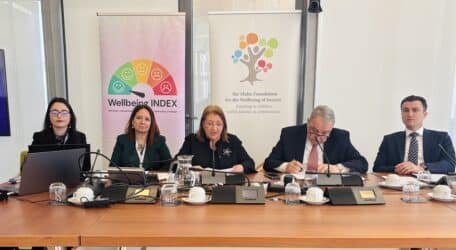
At the same time, the findings show this strength is being tested, according to economist Marie Briguglio, the project’s principal investigator, who presented the data to Parliament with Natalia Mangion during an event to mark the International Day of Happiness.
Today’s event was addressed by Malta Foundation for the Wellbeing of Society founder and chair Marie-Louise Coleiro Preca, Speaker Anglu Farrugia, Economy Minister Silvio Schembri, his Opposition counterpart Jerome Caruana Cilia, University Pro-Rector Valerie Sollars, and National Statistics Office Director Matthew Zerafa.
Launched five years ago by the MFWS and the University of Malta, the Wellbeing INDEX project serves as a vital repository of data and evidence on the island’s wellbeing that goes beyond Gross Domestic Product to capture how people feel about their everyday lives. Its findings can be explored through interactive dashboards on the project’s website.
Ms Coleiro Preca said the data showed that those requiring most attention were the very ill, the poor, the socially excluded and the time-poor.
“This project was born out of the recognition that economic performance measured mainly by GDP growth, often overlooks the fundamental question: Are people in Malta feeling OK?
“Wellbeing should be placed at the heart of governance, policy, and everyday life to ensure our decisions contribute to a society where all individuals can lead fulfilling and dignified lives,” Ms Coleiro Preca said, thanking both sides of the House for their bipartisan support.
The insights emerging from this index are backed by data, with around 10,000 individuals contacted and questioned each year by the National Statistics Office across a number of indicators.
Prof. Briguglio, who leads the research with her colleagues Ms Natalia Mangion and Prof. Joel Azzopardi, said wellbeing in Malta presented a picture of progress, paradoxes, and pressing challenges that could help inform policies, including Vision 2050.
Life satisfaction – A paradox?
The data points to a widening gap between how satisfied people rate their lives and how they actually feel from day to day.
While satisfaction with life, finances, employment, relationships and time use all improved from 2023 to 2024, emotional wellbeing declined across all indicators, with more people reporting frequent nervousness, loneliness, feeling downhearted and depressed, and fewer saying they felt calm and happy. Women reported significantly higher levels of negative emotions than men in 2024.
The data also shows that hardship is becoming more concentrated. While the number of people in “absolute misery” almost halved to 4,408 in 2024 from 8,323 in 2023, some groups continue to face persistently low wellbeing.
People in poor health remain the worst affected – more so than those who are poor – with an estimated 18,070 individuals in poor health recording wellbeing scores, almost two points lower than the national average.
Material deprivation, an indicator measuring whether people can afford basic items, is also a major fault line, affecting 42,524 people in 2024.
Time-poor
Despite increasing over the previous year, time-use satisfaction remains the lowest-ranked satisfaction indicator, recording an average of 6.91. This highlights the growing pressure on daily life. Single parents and households with two adults and two children record the lowest scores, while time pressure is now even emerging among higher-income groups and those with higher levels of education.
Strained living conditions
The data also points to growing strain in neighbourhoods and living conditions. In 2024, 34.5 per cent of the population reported exposure to noise (164,656 individuals) and 37.8 per cent to pollution (180,332 individuals), an increase over the previous year.
Reports of damp walls and leaking roofs rose by 24 per cent over the previous year, affecting 40,652 people, while concern with neighbourhood crime increased by 35.96 per cent (46,664 people).
Problematic social media use
Another warning sign concerns digital wellbeing. The project flags recent findings of high levels of problematic social media use in Malta, with world-record rates among young people. This is strongly linked to lower life evaluation and psychological complaints including irritability, nervousness and sleep difficulties.
Prof. Briguglio told Parliament that while life satisfaction was high, personal relationships were strong, and international rankings were improving, a number of important challenges remained.
“Time poverty, environmental quality, and emotional wellbeing constrain our otherwise very good quality of life. As a nation we need to develop wellbeing interventions to assist individuals in poor health, those experiencing material deprivation, and to address problematic social media use among young people.
“Malta is making progress, but progress must also be felt by those who are struggling the most,” she said.
- March 28, 2026 No comments Posted in: Press Launches Tags: Wellbeing INDEX Project
Related posts
-

Corinthia Palace joins prestigious Virtuoso and American Express Hotel Collection March 24, 2026 | No comments
Corinthia Palace has joined the prestigious Virtuoso global network and the American Express Hotel Collection, marking a significant milestone in the hotel’s continued evolution as one of the Mediterranean’s leading luxury destinations.
-

SOFTSWISS and Pentasia Malta Expert Event Reveals Why Hiring in iGaming Gets Harder in 2026 March 24, 2026 | No comments
SOFTSWISS, a global iGaming software provider, and Pentasia, an iGaming recruitment agency, hosted a talent-focused expert event in Malta. It gathered HR and executive leaders from across Europe to discuss the key challenges in iGaming hiring today and to offer practical frameworks for companies looking to stay competitive in the talent market.
-

Corinthia Hotels, ShiLong Industry Co and Geminus Group Announce Partnership to Launch Corinthia in Chengdu March 18, 2026 | No comments
Corinthia Hotels announces the signing of Corinthia Chengdu in partnership with ShiLong Industry Co and The Geminus Group. Slated to open in 2032, the landmark project marks an important milestone in Corinthia’s continued expansion.
-

Corinthia Rome opens its doors March 18, 2026 | No comments
On the historic Piazza del Parlamento, Corinthia Rome, located on the historic Piazza del Parlamento, opens the doors of a grand neoclassical palazzo, marking the Italian debut for Corinthia Hotels.
