
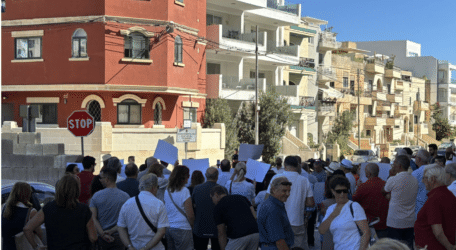
We should not have to be pushed out of our homes
This column first appeared in Malta Today
This week Lovin’ Malta came up with a new satirical series Miss Understanding Malta in which a reporter interviewed the Mayor of Swieqi, suggesting that this town should be turned into one tourist village, while all the residents should move out.
The concept behind this series is to “explore the country’s biggest talking points through dry humour, deadpan reporting and a deliberately unconventional approach to investigate the issues shaping everyday life on the island.” It is a style reminiscent of Striscia la Notizia and Ali Bubakar’s interviews, but without the disguise.
While I can appreciate the attempt at satire, I’m not sure everyone who lives in Swieqi was exactly thrilled with the joke. When your once tranquil neighbourhood has been turned into Party Central for those who want to be a quick 5 minute walk away from Paceville, the black humour falls a bit flat and leaves a bitter taste.
As houses started being knocked down around 2006, with owners selling out to developers who in turn transformed each plot of land into apartment blocks, the residents who have remained have had to endure nightly disturbances, damage to property, rubbish, indecent behaviour and a complete disregard for their rights to enjoy their own homes in peace. Waking up to your doorstep covered with urine or vomit, and the occasional passed out drunk, is not exactly the best way to start your day.
I cite the year 2006 because I came across an article penned by Karen Zammit Manduca from Flimkien Għal Ambjent Aħjar dated 11 June 2006 entitled “Swieqi: A Demolition Zone” in which she described how it all started: “Triq il-Bramel, in Swieqi, was a quiet cul-de-sac, about 70 metres long, which consisted of eight terraced houses and ten maisonettes. A terraced house in Triq is-Sirk, also in Swieqi, which had a large garden, was demolished and this is being redeveloped into garages and apartments.”
She went on to explain that despite objections, the development was approved and that there were at least another three properties displaying development permits. 20 years ago, Ms Zammit Manduca wrote about the noise and dust from the early morning construction works which prevented residents from sleeping, as well as the various cranes and heavy machinery blocking the roads simultaneously. She pointed out how, aesthetically, the area would be seriously impacted, how the value of their homes would be diminished once apartments replaced terraced houses and how it would become impossible to park.
As we now know, her concerns fell on deaf ears, the development increased at an even faster pace, and those who saw the writing on the wall sold their property, packed up and left, creating a domino effect as rows of once family homes tumbled down to be replaced by flats. Things really came to a head when apartments started being sold not for people to actually live there, but as a rental investment, especially for shorts lets and air b ’n’ b, attracting mostly young, rowdy tourists ….leading to the current chaotic situation.
Of course, Swieqi is not the only town to have been adversely affected by this phenomenon, but the reason it stands out and is so often in the news is precisely because of its location (with Sliema and St Julian’s coming a close second as the mayhem spills into these neighbouring towns too). Teenagers and 20-somethings stumbling home from a night out from Malta’s night life next door, tend to continue their partying by turning, for some inexplicable reason, to the destruction of property. We have all seen the reels of damaged cars and bottles being thrown from balconies. To crank things up a notch we are now being regaled with scenes straight out of the movie Babylon, with people getting their kicks by having sex in full public view while a burlesque dancer (or was it a drag queen?) has been filmed using a handrail in a busy Valletta street for an impromptu erotic dance. At this rate, I’m fully expecting someone to erect a stripper’s pole at Triton fountain, branding it as our next tourist attraction.
What’s wrong with this picture? Well, I guess it’s OK for those who are living in areas which are untouched by all this to downplay it: “Oh ajma, what’s all the fuss? They’re having fun, they’re on holiday, let them be, did you forget what it’s like to be young?” But it’s not so fun when you cannot enjoy being in the tranquility of your own home; the home you bought after so much sacrifice. The tongue-in-cheek suggestion in the Lovin’ Malta report for Swieqi residents to simply move out is not so far removed from the truth because, in fact, many have done just that. Valletta residents have also been driven out, the sacrificial lamb at the altar of boutique hotels, loud bars and packed restaurants.
But why should people have to move? Why should we be pushed out of our own homes just so business owners can make a quick buck? Why should any of our towns and villages be pillaged and shorn of their authentic character in the name of mass tourism? And where will it stop – because once they move out of places like Swieqi, where can Maltese families go to find some peace and quiet on this barren, noise-ridden island where there are more cranes than there are trees? Not everyone is in the position to buy an acre of land in the middle of nowhere in Sicily just to breathe clean air and avoid a mental breakdown.
With so many low cost airlines and the air b ’n’ b market making accommodation very affordable even during the peak season, it has never been cheaper to travel to Malta or anywhere around Europe. In fact, the debilitating impact of mass tourism is being felt everywhere and locals have had enough. Last weekend, 20,000 residents filled the streets of Mallorca, protesting against Spain’s mass tourism industry, saying it is putting a strain on local population and infrastructure. Demonstrators called for limits on tourism and urged for a sustainable economic model, pointing out that mass tourism is worsening the housing crisis, increasing living costs, and putting pressure on the island’s environment.
It sounds all too depressingly familiar.
The air b ’n’ b industry is specifically being blamed as the leading cause which has ruined so many of Europe’s picturesque towns and cities. Budapest has imposed a complete ban on air b ’n’ b in the city centre. Barcelona has pledged to phase out all licences by 2028. Even New York City has cracked down on the industry with strict enforcement. Meanwhile a tiny island in France has passed a law making it harder for owners to rent out their property on air b ’n’ b.
What started out as a way for owners to make some money by renting out a spare room to travellers (or their entire property while they themselves were on holiday) has turned into a multi-million Euro commercialised industry. On the local front, Maltese entrepreneurs were quick to realise that investing in a rental property or ten is a sure way to make money hand over fist with short lets rather than a long let. There will be those who will argue that one can do what one likes with one’s own property – I agree, but up to a point. When your rental investment is infringing on my rights to live peacefully in my own home then that is crossing a very definite line.
In the meantime, the frustration and exasperation being experienced in areas like Swieqi is finally being heeded with new laws which were announced to regulate this market. However, the relief on hearing this news was quickly dampened when it was announced that some of the restrictions (such as room capacity) would only apply to new licenses, which effectively exempts thousands of properties. In a show of force earlier this month, the Malta Tourism Authority and community police went on a two day enforcement drive in Swieqi, carrying out 252 inspections. The result shows just how out of control the market is: 67 properties (26.6%) of those inspected were found to have breached one or more licensing or operational requirements, while six properties were discovered to be operating without any licence or authorisation whatsoever and were shut down.
If so many illegalities were uncovered in just two days, imagine how many more could be found if we really took enforcement of our laws seriously, rather than just being words on a piece of paper. Also, if you are going to implement new regulations, they should apply across the board with immediate effect, and without fear or favour, even for those properties which already have a license.
Unless we take the bull by the horns, the statement by the Tourism Minister that “the quality and reputation of Malta’s tourism industry depend on the seriousness with which we enforce the regulations,” will be just one more example of satire.
- August 2, 2026 No comments Posted in: Opinion column Tags: Swieqi, air b n b, protests, residents, tourism
Related posts
-

Was it a ‘runaway jury’ or did the prosecution simply fail to prove its case? September 13, 2026 | No comments
Hot on the heels of the “not guilty” verdict in the Yorgen Fenech trial which left (almost) everyone reeling and more conspiracy theories than you can shake your fist at, fresh news emerged which continue to stun an already shell-shocked nation.
-

A trial by jury; a trial by public opinion September 6, 2026 | No comments
On Wednesday evening, I forgot my phone at home, which rarely happens. So when I first heard the news from the friends I was with, I thought surely that can’t be right. They showed me their phone and there it was, spelled out in black and white.
-

Dolly and Hayden: Two deaths, two very different lives August 30, 2026 | No comments
Actress and singer Hayden Panettiere died last Sunday in her prime, at the age of 36. She went into cardiac arrest, after a possible overdose, although this has not yet been confirmed.
-

Men who kill …the verdicts, the suicides, the pending cases August 24, 2026 | No comments
VERDICTS In 2026 (4 years later) Roderick Cassar was sentenced […]
